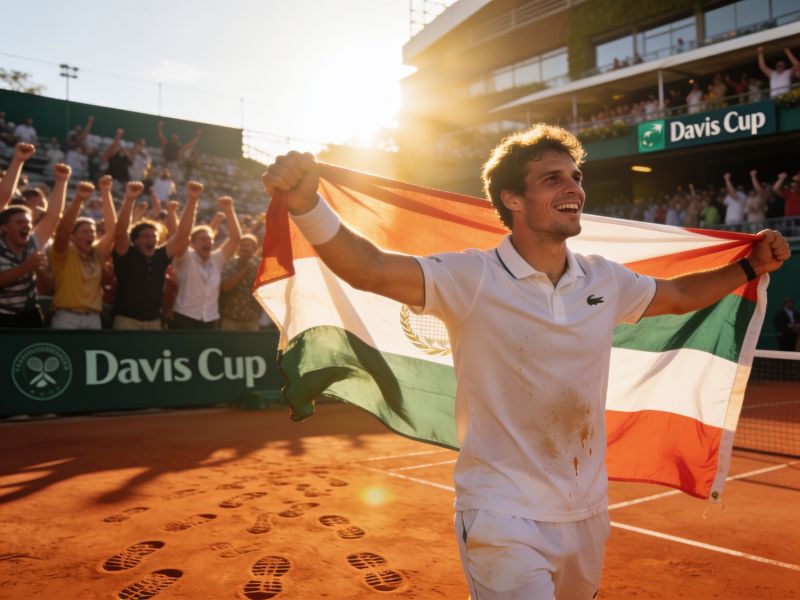
he Davis Cup isn't just another tennis tournament—it's a 125-year-old institution that has weathered wars, format revolutions, and the rise of professional Grand Slam dominance. When Italy lifted the trophy in 2023, ending a 47-year drought。the emotional weight on players like Jannik Sinner and Lorenzo Musetti was palpable. That's the Davis Cup effect: it turns individual athletes into national standard-bearers, often with unpredictable results.I've watched Davis Cup ties in half-empty arenas and packed bullrings. The atmosphere varies wildly—from a raucous Argentine crowd chanting through the night to a subdued indoor court in Glasgow. What stays constant is the tactical chess match. Captains like Serbia's Viktor Troicki or Australia's Lleyton Hewitt make lineup calls that can swing a tie before a single ball is struck. Home advantage isn't a cliché here;
surface selection alone can neutralize a higher-ranked opponent. Spain on clay?A nightmare for fast-court specialists. The 2019 format change to a week-long Finals was supposed to streamline this, but it also diluted the home-and-away magic that made Davis Cup unique. Players grumbled. Fans debated. The ITF tinkered again in 2022, restoring some traditional elements. Honestly, the competition still feels like it's searching for a stable identity.Look at the numbers: 140+ nations compete across four regional zones. That's not just elite tennis—it's a development pipeline. Countries like Colombia and Kazakhstan have used Davis Cup ties to expose young players to pressure they'd never face on the Challenger circuit. I remember watching a 19-year-old Alejandro Davidovich Fokina clinch a decisive rubber for Spain in 2019;he later credited that match for his Grand Slam breakthrough. The Davis Cup forces players to perform without ranking safety nets. No best-of-three cushion, no lucky loser entry. You lose, your country loses. That psychological load can break some and forge others.Critics argue the Davis Cup has lost luster against the ATP Cup and Laver Cup. Fair point—the calendar is crowded, and top players often skip ties to protect their bodies. But the Davis Cup still delivers moments no exhibition can replicate: Croatia's 2018 triumph with a squad nobody rated, or Canada's 2022 title run led by Felix Auger-Aliassime. These aren't scripted all-star events;
they're gritty, messy, and real. The competition's future hinges on balancing tradition with player welfare—a tension the ITF hasn't fully resolved. Still。when a fifth-set tiebreak decides a tie and an entire nation holds its breath, the Davis Cup proves why it matters.